| Category | Details |
| Title | What I Love About Art (Season 46) |
| Air Date | March 5, 2016 (HBO) / April 3, 2017 (PBS) |
| Primary Theme | Creative Expression & Breaking Rules |
| The "Telly" Conflict | Functional Fixedness (Crayons must be used for drawing) |
| Abby's Innovation | Using crayons as building blocks; painting with a rubber chicken |
| Artistic Techniques | Color mixing, Sculpting with "junk," Mixed Media, Time-lapse art |
| Telly's Masterpiece | "Shark Moon Rising Over the Soup Pyramid" (Found-object sculpture) |
| Musical Anthem | "So Many Ways to Make Art" (Nina and the gang) |
| Murray's Escuela | Art School (Drawing and painting fish with kids) |
| Elmo’s World | Drawing (Focus on lines, shapes, and personal expression) |
| The "Grover" Factor | Grover acts as a salesman, introducing the "Rubber Chicken" tool. |
| Key Muppets | Telly, Elmo, Big Bird, Abby, Grover, Murray, The Count, Cookie |
| Human Cast | Nina (The patient art mentor and facilitator) |
| Letter of the Day | A (Art, Artist, Abby, Anyone, Abstract) |
| Number of the Day | 18 (Count's stomp; 18-piece puzzle in time-lapse) |
| Educational Focus | SEL (Overcoming Frustration), STEM (Color Theory), Literacy (A) |
| Sponsors | A, 18 |
Facts
Weird Art Supplies
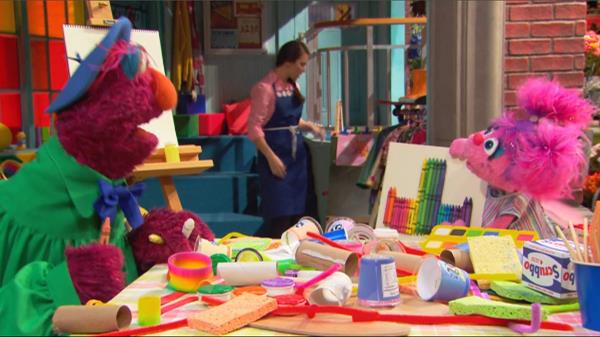
Abby Cadabby makes a rainbow castle by sticking crayons to a board instead of drawing with them. Telly's confused by the unconventional use of materials, since he thinks crayons have strict rules. You'll see that the "crayons" used by the puppet were actually painted wooden dowels. Real wax crayons would've melted under the intense heat of the studio's overhead stage lights.
The Rubber Chicken Technique
Grover shows up as a salesman with rubber chickens for slapstick routines. Abby repurposes one of the chickens as a paintbrush. The prop department used a special kind of silicone to make the chicken so that it could hold and release paint without staining the puppet's fur. You'll notice the resulting artwork features unique textured patterns that Nina identifies as modern art.
Nina's New Role
Suki Lopez plays Nina, the newest human resident of the street. She works at the bike shop and laundromat. This is one of her earliest appearances where she acts as a mentor for the Muppets. Her character was designed to represent a bilingual and tech-savvy generation. You'll notice she uses a smartphone to help the characters look up information, reflecting the show's modernization in 2016.
Shark Moon Masterpiece
Telly gets past his creative rut by making a sculpture called Shark Moon Rising Over the Soup Pyramid. This complex prop was built using recycled materials like cardboard tubes and plastic containers. The designers spent three days putting the sculpture together to make sure it looked like a child made it, but that it was still structurally sound for filming. You'll notice it has a shark puppet's head as a central element.
The Scrapkins Connection
The Murray Has a Little Lamb segment visits a "recycled art school." It's actually based on the real-world Scrapkins brand that Brian Yanish created. Brian himself shows up in the segment to teach the kids how to make "tube monsters" from old cereal boxes and paper towel rolls. It's all about sustainability, showing you how to turn trash into cool gifts.
Digital Art Refresh
The Elmo's World: The Drawing Segment is a high-def re-edit of the original 1999 episode. To update the footage, editors used digital color correction to brighten the "crayon-drawn" background. You'll be surprised to find out that the animated characters like Drawer and Shade were originally performed using real-time motion capture. For this 2016 version, the animation was cleaned up to look crisper on modern widescreen TVs.
Hidden Lin-Manuel Rap
The theme song for the Murray segment was written and performed by Lin-Manuel Miranda. In this episode, the song is a bit shorter to fit the thirty-minute runtime. You can hear his distinct fast-paced lyrical style as he introduces Murray and Ovejita. This collab happened years before he became a global sensation with the musical Hamilton.
Artistic Counting
Today's number is 18, and to celebrate, there's a time-lapse video of a guy putting together a puzzle. This puzzle has exactly eighteen pieces shaped like art supplies. You'll notice the Count von Count stomp segment uses a new drum track to make the rhythm more prominent. This auditory cue helps you count along with the puppets as they strike the floor.
Educational Context & Viewer Guide
Primary Lesson: Creative Expression and Overcoming Perfectionism
Pedagogical goal: Show that art is subjective and that there's no "right way" to create, encouraging kids to experiment with different materials, colors, and techniques.
Parental Note: Telly Monster is feeling pretty frustrated because he thinks there are strict rules for making art. When Abby Cadabby uses crayons to build a castle instead of drawing with them, or paints with a rubber chicken, Telly gets worried! Nina helps him understand that art is about using your imagination. If your child ever feels "stuck" while drawing, this is a great episode to revisit. You can try a "Mystery Box" art project at home. Just put random items like sponges, bottle caps, and string in a box and see what kind of "sculpture" you can make together!
Expert Take: This episode is all about divergent thinking, which is basically the ability to come up with creative ideas by exploring a bunch of different solutions. Telly's all about "Convergent Thinking," which is basically looking for the one right answer. That's why he's having a bit of a creative block. They use different materials like crayons, paints, and even "junk" for sculptures to show how art can be a process. The focus is on the process rather than the final product. Nina also taught a class on color theory, where she showed how to mix paints to make new colors.
The number of the day is 18. The Count leads the group in a song and a stomp. This helps toddlers reach a counting milestone. There's a video of a guy putting together a puzzle that looks like the number itself. This helps improve spatial awareness and visual literacy. When you link the number to a building process, it makes the math feel like part of an artistic theme. Your child can build number recognition skills by doing this creative task.
Telly joins Nina for an art session. Big Bird and Elmo make traditional drawings. Abby Cadabby uses her crayons to build a 3D castle. She even paints with a rubber chicken. Telly's feeling stressed because he thinks art has to follow strict rules. Nina and Abby help him understand that imagination has no limits. Telly eventually finds his own spark. He makes sculptures out of junk. This story helps your child learn about cognitive flexibility and self-esteem. Innovation comes from trying new things and seeing what works for you.
Elmo and his friends introduce the letter A by singing and dancing to show that A is for art. This connects the letter sound to the day's theme. Using music helps kids remember new letters. You can practice the letter A at home by looking for art supplies.
Ovejita leads Murray to a school where the clue is a paintbrush. This trip shows kids that art is something you can practice and share. Murray and the other kids paint pictures of fish. This activity is great for improving fine motor skills and getting people to work together on creative projects. Your child learns that an art school is a place for self-expression. It's interesting to watch a bunch of different kids using all kinds of tools.
Elmo looks at how lines and colors tell a story. This segment supports visual literacy. Your child will learn how people use drawing to express feelings and ideas. Cookie Monster recites a poem about kindness. He shares a cookie with Rosita to show her what he means. These stories strike a nice balance between the fine arts and the art of being a good friend. The most important part of any creation is the empathy you put into it.
There's a film called Anyone Can Be an Artist that shows people of all ages being creative. This segment is all about diversity and inclusivity. It's a great reminder for preschoolers that art is for everyone. When kids see a variety of artists, it builds their confidence. Your child learns to try new things without being afraid of making mistakes. The world is like a canvas, and every kid can add their own color to the neighborhood.